
India's Fragrance Legacy: The Ancient Art That Inspires Berry Roots™ Brand-forward, heritage-driven, personal to Berry Roots™
From the sacred rituals of ancient India to the niche fragrance houses of today — a journey through one of the world's greatest aromatic traditions.
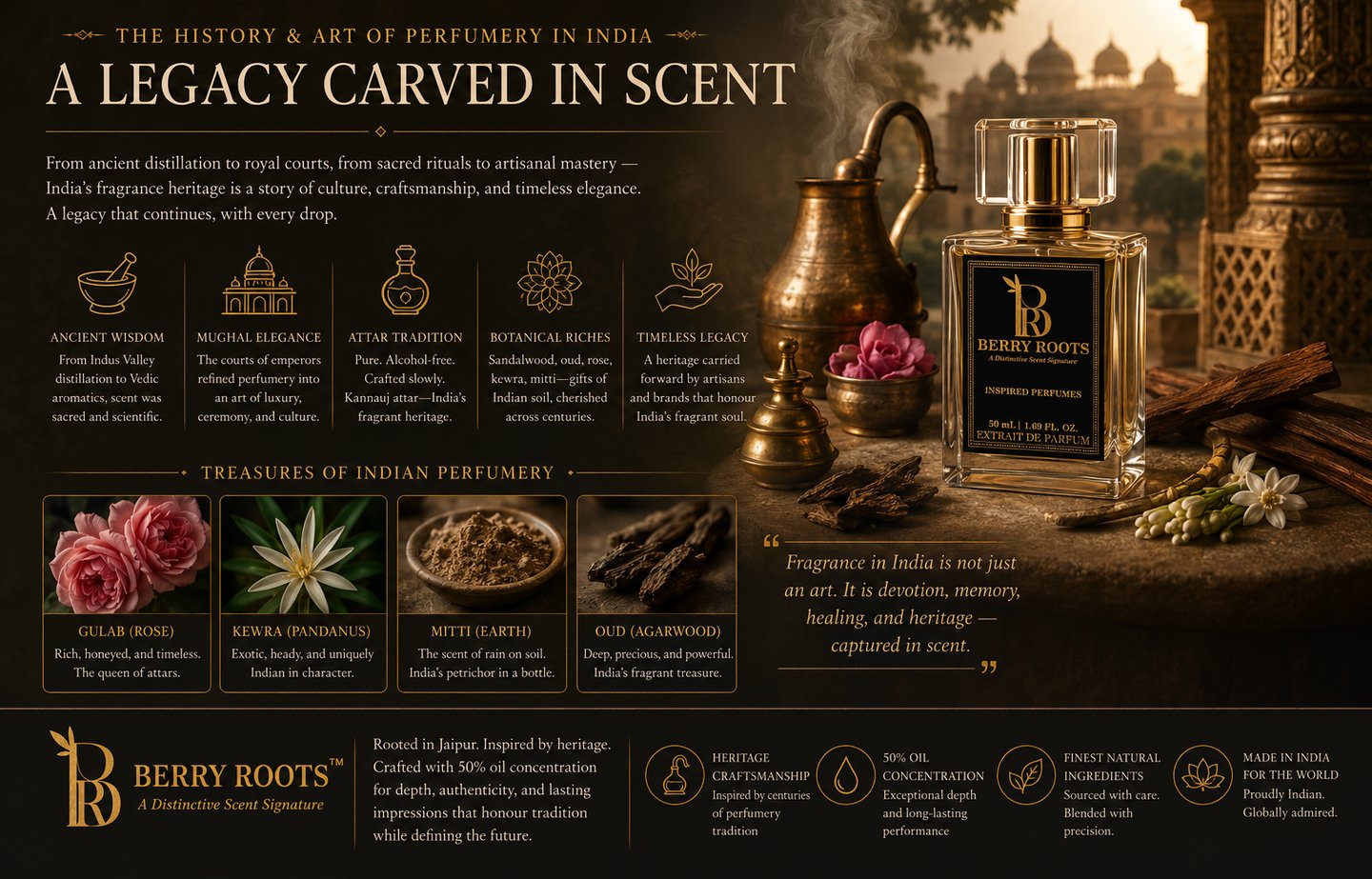
# The History & Art of Perfumery in India: A Legacy Carved in Scent
By Berry Roots™ | Fragrance Heritage
---
India's relationship with fragrance is not a modern one. It is ancient, layered, and deeply woven into the cultural, spiritual, and social fabric of one of the world's oldest civilisations. Long before the word "perfume" entered the European lexicon, India was already a civilisation that understood the language of scent — using it in ritual, medicine, trade, and daily life with a sophistication that the rest of the world would take centuries to approach.
To understand Indian perfumery is to understand a tradition that has been continuously refined over more than four thousand years. It is a story of botanicals and resins, of ancient trade routes and royal courts, of artisans who devoted their lives to the mastery of aromatic extraction. And it is a story that continues today — carried forward by brands like Berry Roots™, rooted in Jaipur, that honour this legacy while shaping its next chapter.
---
## The Ancient Origins: Vedic India and the Birth of Aromatics
The earliest recorded evidence of perfumery in India dates to the Indus Valley Civilisation, approximately 3000 BCE, where archaeological excavations have uncovered clay distillation vessels at sites including Taxila and Harappa. These early stills — remarkably sophisticated for their time — were used to extract aromatic compounds from flowers, herbs, and resins, suggesting that the science of fragrance extraction was already established long before recorded history.
The Vedas, among the oldest written texts in the world, contain extensive references to aromatic substances. The Rigveda and Atharvaveda document the ceremonial use of incense, fragrant woods, and aromatic oils in rituals of worship, healing, and purification. Scent in Vedic tradition was not ornamental — it was sacred. It was believed to carry prayers to the divine, to purify space, and to connect the physical world to the spiritual.
Sandalwood, which remains one of India's most iconic and globally coveted aromatic materials, was referenced in Sanskrit texts as chandana — a substance of exceptional purity and spiritual significance. Its use in temples, in ceremonial anointing, and in the preparation of the deceased reflects the depth of reverence with which Indian civilisation has always approached fragrant materials.
---
## Attar: The Soul of Indian Perfumery
No discussion of Indian fragrance heritage is complete without attar — the hydro-distilled natural perfume that represents the highest expression of traditional Indian perfumery.
Attar, derived from the Arabic word itr meaning fragrance, is produced through a process of steam or hydro-distillation in which aromatic plant material is distilled directly into a base of sandalwood oil. The process is extraordinarily slow and precise — a single kilogram of high-quality rose attar, for example, requires several thousand kilograms of rose petals and many hours of careful distillation. The result is a fragrance of unparalleled complexity and naturalness, entirely free of alcohol, that warms and evolves uniquely on the skin.
The town of Kannauj in Uttar Pradesh is known as the perfume capital of India — a city that has been producing attar for over a millennium. The traditional deg-bhapka method used by Kannauj artisans is virtually unchanged from its Mughal-era origins, and Kannauj attar has been recognised internationally for its extraordinary quality. In 2021, the geographical indication of Kannauj Attar was formally registered, acknowledging it as a protected and uniquely Indian heritage product.
Among the most celebrated Indian attars are:
Gulab (Rose) — distilled from the petals of Damask rose, producing a rich, honeyed floral of extraordinary depth.
Kewra (Pandanus) — extracted from the flowers of the screwpine tree, yielding a distinctive, heady floral with a slightly aquatic character unique to Indian perfumery.
Mitti (Earth) — perhaps the most uniquely Indian of all attars, distilled from baked earth and capturing the scent of rain on dry soil — the phenomenon known globally as petrichor. Mitti attar is one of the most emotionally evocative fragrances in existence, and one that can only be truly understood in an Indian context.
Oud (Agarwood) — while oud is associated broadly with Middle Eastern and South Asian perfumery, India produces some of the world's finest agarwood from the forests of Assam, valued internationally at prices that rival precious metals.
---
## The Mughal Influence: Fragrance as Imperial Art
The Mughal Empire, which reached its height between the 16th and 18th centuries, elevated Indian perfumery from a craft tradition to a formal art. The Mughal courts were legendary for their appreciation of fragrance — emperors and empresses alike maintained vast collections of attars, fragrant oils, and aromatic compounds, and the royal hamam (bathhouse) was a space of elaborate aromatic ritual.
Empress Nur Jahan, one of the most influential figures of the Mughal court, is credited in historical accounts with the accidental discovery of rose water and rose oil — stumbling upon the aromatic film floating on the surface of a floral bath that had been warmed by the sun. Whether legend or history, the story reflects the centrality of fragrance in Mughal court culture.
Emperor Akbar's court historian Abu'l-Fazl documented in the Ain-i-Akbari that the emperor burned 120 kilograms of oud wood annually in the imperial court, and that the preparation of royal attars was considered a matter of state importance. Fragrance was not personal indulgence in the Mughal court — it was diplomacy, ceremony, and identity.
This Mughal legacy established the foundations of North India's attar trade, and cities like Jaipur — home of Berry Roots™ — became important nodes in the aromatic commerce of the subcontinent.
---
## Jaipur: A City Steeped in Fragrance
Jaipur, the Pink City of Rajasthan, carries a particularly rich aromatic heritage. The royal courts of the Kachwaha Rajputs were known for their appreciation of fine fragrance, and the city's historic bazaars — particularly those in the walled city near Johari Bazaar and the old spice markets — have traded in aromatic materials for centuries.
Rajasthan's desert climate, abundant botanical diversity, and proximity to the great attar-producing centres of North India made Jaipur a natural home for fragrance commerce and culture. The rose cultivation of the surrounding region, the trade in sandalwood and resins, and the long tradition of aromatic use in Rajasthani ceremony and hospitality all contributed to a city with a deeply embedded relationship with scent.
It is in this city, with this heritage beneath its feet, that Berry Roots™ was founded. Not by accident — but by conviction that Jaipur's aromatic legacy deserves to be carried forward in a form that speaks to the contemporary Indian consumer and to the world.
---
## Modern Indian Perfumery: A Renaissance in Progress
Indian perfumery today is experiencing a renaissance. A new generation of fragrance houses is drawing on the country's extraordinary botanical heritage — its roses, its sandalwood, its agarwood, its spices — and reinterpreting them through the lens of contemporary luxury perfumery.
This movement sits at the intersection of tradition and modernity. It honours the ancient knowledge of Indian aromatics while embracing global standards of formulation, concentration, and presentation. It recognises that Indian consumers — long offered a choice only between inexpensive local products and imported luxury brands at prohibitive price points — deserve something better.
Berry Roots™ was founded on precisely this conviction. As a niche perfume brand rooted in Jaipur, we draw on India's aromatic heritage while delivering luxury-inspired formulations at 50% oil concentration — fragrances that perform at the level of the world's finest perfume houses, priced for the Indian market without compromise.
The story of Indian perfumery is four thousand years old. Berry Roots™ is proud to be writing its next chapter.
---
## The Materials That Define Indian Fragrance
For those who wish to understand the aromatic vocabulary of India, these are the materials that have shaped its perfumery tradition:
Sandalwood (Chandan) — warm, creamy, and meditative. The finest Indian sandalwood comes from Karnataka and is among the most valuable aromatic materials in the world.
Rose (Gulab) — the Damask rose of Kannauj produces one of the world's most complex and emotionally resonant floral absolutes.
Vetiver (Khus) — earthy, smoky, and cooling. Widely used in Rajasthani and North Indian perfumery, and one of the great base notes of global perfumery.
Agarwood (Oud) — dark, complex, and resinous. Indian oud from Assam is considered among the finest grades globally.
Jasmine (Mogra) — the Indian variety, Jasminum sambac, produces an absolute of extraordinary richness and sweetness, distinct from its Mediterranean counterpart.
Tuberose (Rajnigandha) — heady, creamy, and intensely floral. A signature of Indian festive and ceremonial fragrance.
Musk (Kasturi) — historically derived from the musk deer of the Himalayas, now responsibly recreated through synthetic musks that capture its warm, animalic character.
---
## In Summary
India's perfumery heritage is among the richest and most sophisticated in the world. From the aromatic rituals of Vedic civilisation to the imperial extravagance of the Mughal court, from the artisanal attars of Kannauj to the emerging niche fragrance brands of contemporary India — this is a tradition of extraordinary depth, diversity, and beauty.
Understanding this heritage enriches the experience of every fragrance you wear. It connects a moment of personal pleasure — the ritual of applying a perfume — to a lineage of human knowledge and artistry that stretches back thousands of years.
At Berry Roots™, we wear that heritage with pride. And we invite you to carry it forward with us.
---
Explore the Berry Roots™ collection at [berryroots.store](https://www.berryroots.store/) or reach us on WhatsApp at +91-8440036003.
---
© Berry Roots™ | Jaipur, Rajasthan
Address
14 B, ANAND BHAWAN, JOBNER BAGH, STATION ROAD, JAIPUR, RAJASTHAN 302006